The UW SON’s Center for Global Health Nursing and the Alaskan Native Tribal Health Consortium (ANTHC) is recruiting experienced and newly graduated FNPs to work in Alaska for 12 month period beginning July 1, 2020. These candidates will become part of the second cohort of DNPs to participate in the prestigious UW Global and Rural Health Fellows Program. DNP-FNPs will have the opportunity to practice in Alaska at tribal clinics supported by the Alaska Native Tribal Health Consortium (ANTHC) and become part of a cohort that includes recent UW SOM internal medicine and emergency medicine fellows. Subsequently, Fellows may extend for another year in Alaska or participate in a 3-month global health fellowship focusing on community health and/or applied research in Kenya, Peru, or Nepal.
Fellows will benefit from monthly skype-based seminar meetings with UW faculty, inter-professional education with their fellowship cohort, and faculty mentorship throughout the duration of their fellowship, including during the development of a community outreach/quality improvement activity. Fellows will participate in a one month, on-site global health course during the first year of the fellowship at UW (housing stipend provided).
The UW Center for Global Health Nursing (CGHN) is excited to announce a new partnership with Omprakash, a Seattle-based global education nonprofit, which will increase study abroad opportunities for both undergraduate and graduate-level UW nursing students. Omprakash works with organizations around the world to create internships where they need help the most. They created the UW Global Research, Internships and Service Program (GRISP) which enrolls students in a pre-departure training course so students can get the most out of their internship and avoid common mistakes while abroad.
To learn more about how you can participate in this new program, please take a look at the program website here.
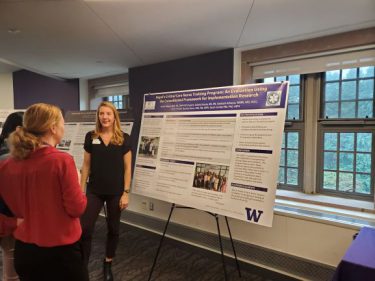
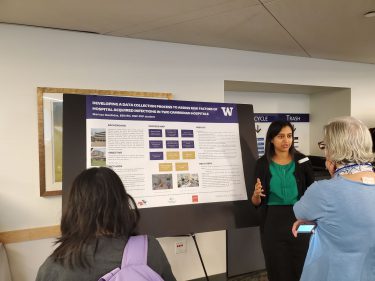
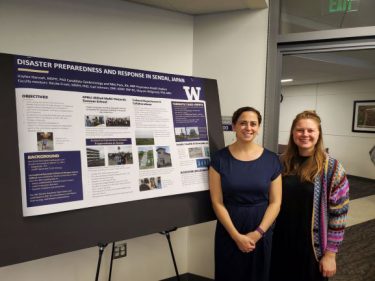
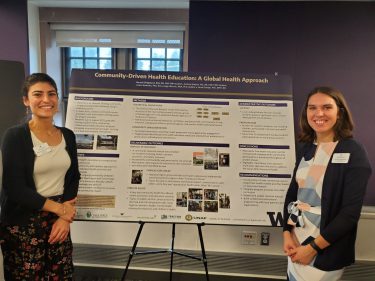
On November 14th, multiple departments came together to hear Sheila Davis speak about the growth of Partners in Health over the past 30 years. The event started with poster presentations from students engaged in global health projects over the past year. Andrea Shelton (DNP-Midwifery), Hannah Bridgeland (DNP-FNP), Nicole Bayard (DNP-FNP), Marissa Masihdas (DNP-FNP), Rikki Peck (DNP-FNP), and Haylea Hannah (PHD Candidate – Public Health) all presented about their work in Peru, Nepal, Cambodia and Japan.
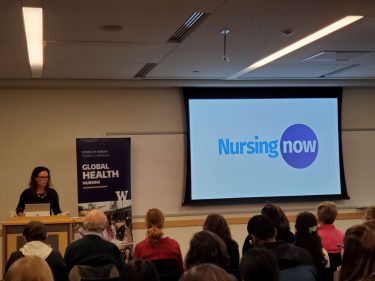
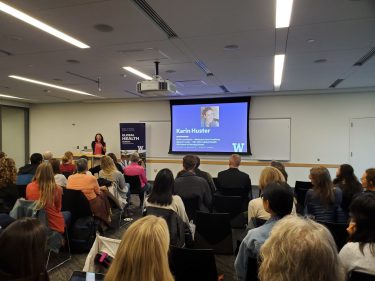
Sarah Gimbel, Co-Director of the Center for Global Health Nursing had a chance to introduce the School of Nursing and its commitment to the year of the nurse and midwife as presented by Nursing Now. She was pleased to welcome Karin Huster, an alumnus of the UW School of Nursing, who now works for Médecins sans Frontiers as a site coordinator and has worked closely with our keynote speaker, Sheila Davis.
Sheila Davis, CEO of Partners in Health, took the stage to discuss Partners in Health after 30 years and how the role of the nurse is important in the organization’s mission and in the overarching goal of global health equity. Sheila took the audience on a trip through her nursing career which has led her to become the CEO, how the organization is embracing her perspective as a nurse and the steps nurses must take in the future in order to care for the world’s most vulnerable populations.
The Center for Global Health Nursing wants to thank the UW School of Nursing, the Population Health Initiative, I-TECH, and the Department of Global Health for helping sponsor this event.
November 14th, 2019 at HUB 250 Poster viewing 2:30 – 3 pm, Presentation 3 – 4 pm
Dr. Sheila Davis is the Chief Executive Officer at Partners In Health (PIH). Previously, she served as Chief of Clinical Operations and as Chief Nursing Officer, where she oversaw nursing efforts as well as supply chain, medical informatics, laboratory, infrastructure, and quality improvement activities. Starting in 2014, she served as the Chief of Ebola Response as she led PIH’s response efforts during the West Africa epidemic. She has been a nursing leader in the field of HIV/AIDS since the mid-1980s and served on the National Board of the Association of Nurses AIDS Care (ANAC). She entered the global health arena in 1999 responding to the global HIV pandemic working in a number of countries. She was the co-founder of a small NGO that worked in South Africa and Boston from 2004-2010 on health projects, including a rural village nurse clinic. Dr. Davis is a frequent national speaker on global health and clinical topics including HIV/AIDS, the Ebola epidemic, leadership in public health, and the role of nursing in human rights.
Dr. Davis received her BSN degree from Northeastern University in 1988, her Masters in Nursing degree as an Adult Nurse Practitioner in 1997 and her Doctorate in Nursing Practice with a concentration in global health in 2008. Both of her graduate degrees are from the MGH Institute of Health Professions. Dr. Davis was a faculty member at the School of Nursing at the MGH Institute of Health Professions for 4 years and an Adult Nurse Practitioner at the MGH Infectious Diseases outpatient practice for over 15 years. Currently, she is Adjunct faculty at the UCSF School of Nursing and an affiliate member of Ariadne Labs. She was inducted as Fellow in the American Academy of Nursing in 2008 and in 2009 was inducted as a member of the inaugural class of 12 Carl Wilken’s Fellows working on anti-genocide global efforts as part of the Genocide Intervention Network.
Dr. Davis will join the Center for Global Health Nursing as part of UW Global Month, a university-wide initiative to highlight UW’s global impact, networks, and community. She will be speaking on the importance of advocating for nursing in global health with real-life cases from her work with PIH and will talk about the evolution of the organization. The event will also highlight student nurses and the global impact they have made while at the UW.
Two School of Nursing students were part of the Population Health Initiative’s 2019 Applied Research Fellowship. Jane Kim (DNP Student) and Michelle Shin (PhD Student) spent 10 weeks during the summer to analyze the maternity and infant wraparound services provided by First Steps to low-income individuals. To learn more about their findings and more about the fellowship offered by the Population Health Initiative,
The Center for Global Health Nursing and the School of Nursing are pleased to welcome Kathy McCarty as she visits University of Washington School of Nursing on September 12th and 13th. She will be speaking about “Practicing Health Care in a Rural Zimbabwean Setting” at 11 am – 12 pm on Thursday September 12th in HSB T661, immediately following her presentation she will welcome an open forum brown bag session where attendees can sit down with her.
Kathy McCarty is a long-term advanced practice nurse in Zimbabwe, at Chidamoyo Hospital, Ms. McCarty got her credentials and started her nursing practice in California. Ms. McCarty was motivated into pursuing a nursing career after a visit to Zimbabwe in the mid-70s—where she realized acquiring nursing skills could help her contribute to care provision in settings such as Zimbabwe. Kathy has been practicing in Chidamoyo—a rural hospital near Karoi, Zimbabwe, since 1991. As the Sister-in-Charge at Chidamoyo, Kathy has many responsibilities besides administrative tasks and clinical care, such as supervising all nursing staff in the hospital, and in their outreach clinics. Kathy has also housed and mentored hundreds of Zimbabwean and international students who are interested in a variety of health careers including nursing, medicine, physical therapy, physicians’ assistants, and lab scientists. Under her direction, Chidamoyo serves as a research site for many collaborative research projects related to improving HIV care among children, teens, and adults. In addition, Chidamoyo served as a site for an implementation science project examining how to incorporate HPV self-sampling among women in the community and HPV testing in the early detection and prevention of cervical cancer. She maintains a blog about her experiences at Chidamoyo which you can check out here. You can also read more about her research about HPV testing here
Registration time is upon us, and we are pleased to offer NURS 581: Global Health Nursing again this Autumn Quarter. This course has been designed by Co-directors, Sarah Gimbel and Pamela Kohler, to explore the health provider perspective and will give students an overview of global health equity. Instructor Sarah Gimbel will lead the class in discussions regarding:
• Global health measurement frameworks and global benchmarks
• UN Sustainable Development Goals
• Infectious and non-communicable diseases and injury
• Maternal, adolescent, and child health
• Workforce and human resources for health
• Emergency preparedness and management
This course is co-listed in the Department of Global Health as G H 574: Special Topics in Global Health and is listed as an accepted elective for graduate certificates in International Humanitarian Response, Global Health or Global Health of Women, Adolescents, & Children. Please contact the Center for Global Health Nursing (cghn@uw.edu) with any questions regarding this course listing. All graduate health science students are encouraged to register. Undergraduates may be considered with instructor permission.
Andrea Shelton and I have had a busy couple of weeks here in Iquitos. Our last couple of weeks have centered around continuing the Academia Familiar del Amazonas (AFA) program started by last year’s Peru Scholars. The intention of this program is to support the women of the Claverito Community with education sessions addressing issues they have identified as priorities. Therefore, we spent a week planning and implementing a community meeting meant to identify their priorities. We even held a train the trainer’s event where we prepped two facilitators on the planned activities and purpose of the meeting.
All were welcome at the community meeting for women.
The community meeting was held on a Sunday morning on the newly built community platform and was a huge success! All women ages 12 and over were invited to the meeting. We divided the women into two groups based on age: 12-17 years old and 18 years old and up. Then everybody completed two activities where they wrote down specific subjects they wanted to discuss. Subjects did not have to be directly related to their physical health, but all are linked to their overall well-being in some way. We were so pleased and excited to see the women express interest and a willingness to be part of AFA. We could not have completed this community meeting without tremendous help from members of the community and members of the InterACTION Labs team. When we arrived at the community on Sunday morning, members of the community had already put up a tent, table, and chairs for the women. The UW medical students and landscape architect students kept all of the little kids entertained with coloring while two members of the greater Iquitos community ran the meeting.
Members of the InterACTION Labs team setting up for the community meeting on the new platform.
The next week was spent translating the answers and determining what local resources are available for addressing the identified priorities. We are now in the process of visiting several local government offices in order to learn about services already available and how Claverito community members can access the services. Since several resources are already available in Iquitos, our goal is to make sure the women know what services are available and how to access them.
Andrea Shelton and I outside the hospital before our first shadow experience.
We have also been shadowing several doctors and nurses in the maternity ward of the Regional hospital, Felipe Santiago Arriola Iglesias.” We were allowed to attend two births and multiple lectures. Besides the births, my favorite part was getting an in-depth description of the World Health Organization’s form used in the hospital to track progress during labor and determine high-risk situations.
For fun over the last couple of weeks, we have been exploring Iquitos and the Amazon. We spent a couple of days in the Amazon jungle fishing for piranhas, bird watching, searching for monkeys and learning what plants people living in the jungle use for medicine. We took a boat ride around Claverito community to look at the vegetation islands that get created as the Amazon water level rises. We saw countless different birds and plants. The water level is receding quickly and in about two weeks we will be able to walk through this same area! We also participated in a local “marathon” that is a fundraiser for four local houses serving vulnerable populations. We were very concerned at first because the race was being advertised as a marathon. Needless to say, we were very relieved to find out the marathon was a four-kilometer walk/run!
Members of the InterACTION Labs team wearing our race t-shirts. Andrea Shelton and I on the Amazon River during our jungle adventure.
The Center for Global Health Nursing is excited to share that the Population Health Initiative has launched a new 15-credit Graduate Certificate in International Humanitarian Response. Beginning this fall, the certificate is an interdisciplinary program through the UW Graduate School, and connects professionals from Public Health, Law, Public Policy, Engineering, Nursing, Pharmacy, Built Environment, and more. This certificate program is intended for graduates and professionals to study prevention, mitigation, response, and recovery from crises.
Hannah Bridgeland and Andrea Shelton arriving in Iquitos, Peru
Andrea Shelton and I arrived in Iquitos, Peru on July 1 eager to meet the Claverito community members and get to work on our projects. The weather is not nearly as hot and sticky as we expected, so we are both quite relieved about that surprise! During this first week we got a taste of Amazon weather with mostly warm, sunny days broken up by brief, unexpected showers. This weekend we experienced Amazon rainstorms along with the street flooding and loss of internet and slippery sidewalks that comes with the large amounts of water. So far, we have only got caught in the rain once, so we are surviving the unpredictable weather of the Amazon well!
Andrea Shelton with Lorenzo the Parrot
We have a beautiful apartment situated on the Malecón Tarapaca, which is a large walkway filled with shops, restaurants and museums right next to the Amazon. We are a short walking distance to markets, grocery stores, gyms, the program’s office and almost anything else we could want. Andrea made friends with this talkative parrot named Lorenzo in the Mercado Central. He is very proficient in saying, “Hola!” but “Ciao” seems like a challenge.
Hannah Bridgeland in front of the Program Office
The food is wonderful and trying different Peruvian dishes is one of our favorite hobbies! Our first night in Iquitos was celebrated at a restaurant on the Malecón with a variety of different dishes. Andrea is a fan of alligator meat while my jaw gets tired from chewing the tough meat! We both agree the ceviche, especially the sauce put on ceviche, is amazing, and we could get used to the consistent supply of fresh pineapple, papaya, oranges, and granadilla.
Besides getting settled into life in Iquitos we have been busy this week learning about the InterACTION Labs projects, the Claverito community and the specific needs of this part of Peru. Together with a first-year medical student, we created a presentation for the other members of the InterACTION Labs team highlighting our research findings on the most prevalent health and environmental issues in Iquitos. The most prevalent health issues facing the Claverito community, which is a floating, migrant community, are different from the rest of the city. From our previously collected data we have identified high rates of teenage pregnancy, tuberculosis, parasitic infections, vector-borne diseases (Malaria, Dengue, Zika), and malnutrition. As expected, our research demonstrated that many of the most prevalent health conditions in Iquitos are modifiable and many are directly related to the environmental issues of the area.
InterAction Labs team sharing a meal in Peru Entrance to Claverito
We have three main activities planned. First, we expect to continue the parenting intervention (Academia Familiar del Amazonas (AFA)) started by the DNP students last summer. This will include development and implementation of 8-week training modules, one for adolescent girls and another for women in the community. Previously identified topics of interest include reproductive health, management of respiratory illness, management of infectious disease, etc. We are meeting with community members this week to finalize their main interests, so we can best meet their expectations. We also plan to support the establishment and functioning of the floating library. The idea to build the library emanated from AFA activities last summer and the funds to support it were mobilized by last year’s DNP cohort. We are so pleased to be working with three UW landscape architecture students as well as the community in the design the library. Finally we are working with School of Nursing faculty and students to further cement collaboration across our institutions.
During our free-time this week, we enjoyed watching Peru’s team compete in the semi-finals and finals of the Copa de Americas tournament. We learned how excited Peruvians are about fútbol and experienced Peruvian spirit firsthand. We also had a potluck for the US women’s world cup championship. We like to think they heard our cheering all the way from Peru!



 The Center for Global Health Nursing is excited to share that the Population Health Initiative has launched a new 15-credit Graduate Certificate in International Humanitarian Response. Beginning this fall, the certificate is an interdisciplinary program through the UW Graduate School, and connects professionals from Public Health, Law, Public Policy, Engineering, Nursing, Pharmacy, Built Environment, and more. This certificate program is intended for graduates and professionals to study prevention, mitigation, response, and recovery from crises.


