Skip to content

Student Profile: Julie Skene

Photo of Julie Skene

Julie Skene is the first nurse to enroll in the DNP- Population Health Nursing & Global Health MPH Concurrent Degree Program (learn more here!) The Center for Global Health Nursing asked Julie a few questions about her passion for nursing and why she decided to pursue this concurrent degree program.

Why did you choose nursing?


I chose nursing because I want a career that involves both helping others and promoting health. Also, there are so many different types of opportunities for nurses, I knew nursing would be a profession in which I could continually grow throughout my career. For example, when I switched from hospital-based nursing to school nursing, my focus changed to improving the health of the whole community. I developed a better understanding of the importance of population health and influencing change at a systems level which prompted my decision to return to school and learn more about global health nursing. 


What has been an unforgettable experience during your time at the School of Nursing?


My DNP practicum at the Chinese Information and Service Center (CISC) for the past year has been unforgettable. Through this experience I have strengthened my cross-cultural nursing skills, learned how to effectively support immigrants and refugees in Seattle, and developed valuable relationships with the amazing staff at CISC. I will never forget how kind and welcoming everyone in the organization has been and how dedicated my CISC colleagues are to the vulnerable populations they serve. 


How has your experience at nursing helped you with your career trajectory?  


My experience has helped with my career trajectory by improving my leadership skills, self-confidence, and professional connections. Through mentorship from inspiring professors, gaining practical experience in the field, and taking a variety of classes, I feel prepared to take my career to the next level. Population Health DNP skills are a valuable resource to all types of organizations, and I am looking forward to finding a position that allows me to use my nursing perspective to work towards improving health globally. 


Why did you decide to pursue a dual degree in Population Health Nursing and Public Health?


I decided to pursue a dual degree because of my strong interest in both nursing and global health. As a school nurse, I enjoyed working with a diverse community of immigrant and refugee families, and I hoped to learn more about how to effectively support these vulnerable populations. Additionally, I wanted to understand how population health-systems can be bolstered globally to make significant, positive impacts on health. 


I knew that pursuing the Global Health MPH degree would strengthen my data analysis skills and result in a more in-depth understanding of global health concerns. While the DNP-PHN program would build upon my nursing knowledge and enhance my leadership and management skills. Together, these two programs support my goal of finding ways to increase access to care for marginalized communities and improve social determinants of health for vulnerable populations.


Can you define the difference between the two programs and how then talk about how they complement each other?

The DNP and MPH degrees complement each other by providing the student with a variety of experiences and perspectives with regards to population health both locally and globally.  As part of the DNP program, I work closely with nursing colleagues to build on our prior experiences and learn how to apply knowledge at a systems-level.

The global health MPH program involves joining a larger cohort of students from all over the world.  We are from a variety of disciplines, so the MPH is beneficial for nurses that seek to broaden their perspective and work with colleagues from other departments.  The MPH program provides a deeper understanding of the history of global responses to health and the political determinants of health.  There are also additional opportunities for practical experience through a practicum and thesis.  I am working at the Department of Health this summer, completing a landscape analysis for the Early Hearing Detection, Diagnosis, and Intervention program.


How do you balance the two programs? 

I’ve balanced the two programs by taking as many global health electives as possible during my first two years of the DNP program.  During my third year,  I completed my DNP practicum along with the MPH required classes.  I will be here for a fourth year to complete the DNP Capstone Project and MPH thesis.


We know that as a part of the MPH Program, you participated in the Student Epidemic Action Leaders (SEAL) Team. Can you talk a little bit about your experience with the SEAL team?

As a member of the SEAL team, I am learning about applied epidemiology through in-person classes, at-home training, and field assignments at the Department of Health.  As a SEAL, I have learned about the Incident Command System, contact tracing, cohort studies, and disease surveillance.   I also completed an assignment working in a specimen accessioning and processing lab.


Study Abroad Updates and Travel Resources

The Center for Global Health Nursing works closely with the UW Office of Global Affairs to track students going abroad and ensuring safe travel. We have been getting a lot of questions regarding travel while restrictions are in place. The UW has put together a very helpful FAQ page that is updated daily with new travel alerts and UW travel policies.

If you have any questions, please visit the site.


Deadline extended for the Global Rural Health Fellowship in Alaska!


The UW SON’s Center for Global Health Nursing and the Alaskan Native Tribal Health Consortium (ANTHC) is recruiting experienced and newly graduated FNPs to work in Alaska for 12 month period beginning July 1, 2020. These candidates will become part of the second cohort of DNPs to participate in the prestigious UW Global and Rural Health Fellows Program. DNP-FNPs will have the opportunity to practice in Alaska at tribal clinics supported by the Alaska Native Tribal Health Consortium (ANTHC) and become part of a cohort that includes recent UW SOM internal medicine and emergency medicine fellows. Subsequently, Fellows may extend for another year in Alaska or participate in a 3-month global health fellowship focusing on community health and/or applied research in Kenya, Peru, or Nepal.

Fellows will benefit from monthly skype-based seminar meetings with UW faculty, inter-professional education with their fellowship cohort, and faculty mentorship throughout the duration of their fellowship, including during the development of a community outreach/quality improvement activity. Fellows will participate in a one month, on-site global health course during the first year of the fellowship at UW (housing stipend provided).

For more information


UW CGHN launches new global internship program with Omprakash

The UW Center for Global Health Nursing (CGHN) is excited to announce a new partnership with Omprakash, a Seattle-based global education nonprofit, which will increase study abroad opportunities for both undergraduate and graduate-level UW nursing students. Omprakash works with organizations around the world to create internships where they need help the most. They created the UW Global Research, Internships and Service Program (GRISP) which enrolls students in a pre-departure training course so students can get the most out of their internship and avoid common mistakes while abroad.

To learn more about how you can participate in this new program, please take a look at the program website here.

Exploration Seminar: Health Services Delivery in Resource Poor Settings in Guatemala

Application Deadline: January 31, 2020 (Applications will be accepted until February 15 on a rolling basis)
Dates: June 22 – August 21, 2020 (in Guatemala July 31- August 15)


This intensive service-learning course, conducted in partnership with a community-based organization, Guatemala Village Health, is designed to expose students to the policy contexts in which health care is delivered in resource-poor settings with particular emphasis on Guatemala. The program will be centered in villages in the mountains above Lake Izabel (Marcajan, Chinavhabilchoch, Chinabengue, and Baltimore) and Rio Dulce, where GVH has cultivated strong partnerships since 2008. 

Guatemala is the most populous country in Central America. It is home to over 15 million people and more than half of the population is below the national poverty line. Guatemala faces several health and development challenges, including infant, child, and maternal mortality, malnutrition, literacy, and contraceptive awareness and use. It is also rich in cultural diversity. This program aims to expose students to global development, health systems, global health issues and health care delivery in resource-strapped communities. The course utilizes the community as the pedagogical platform and challenges students to view global health care issues holistically in order to understand how in-country health policies are influenced by local and global determinants.

For more information, click here.

Exploration Seminar: La Dolce Vita – Comparative Food Systems in Italy

Application Deadline: January 31, 2020
Dates: 6/25 – 7/23/2020

La Dolce Vita: Comparative Food Systems in Italy is a 4-week intensive program exploring sustainable food systems in Italy using systems thinking and a variety of perspectives to understand how factors, such as culture, policy, diet, and market structure, interact to create environmental, economic, health, and social/equity outcomes. The program begins with farmstays in Tuscany, including a coastal, organic farm. Here we will learn about sustainable agriculture and will taste and cook foods. Local speakers will discuss the role of Italian food culture, and contrast production methods and policies in the E.U. and the U.S. Next, students will move to the UW Rome Center to explore the intricate history and patchwork of political, social, cultural, economic, and health drivers that have shaped food systems in Italy, particularly around regional foods. We will survey a variety of retail outlets, will shop for food and prepare meals, setting the stage for a discussion on how dietary choices influence human and planetary health. In Rome, students will meet with civic food networks (e.g., Slow Food Movement), and international food agencies focused on sustainability and food security. Finally, we will travel to the Emilia-Romagna region to tour and reflect on three important Italian products (i.e., balsamic vinegar, parmigiano reggiano, and prosciutto) and to learn about Italy’s mature and growing cooperative economy. Throughout will be a discussion on how to evaluate the evidence to make responsible personal and political choices, and comparisons and reflections of food systems between the U.S. and Italy.

Learn more here.

Exploration Seminar: Health Impacts of the Great East Japan Earthquake

Applications Due: February 15, 2020
Dates: 8/23-9/13, 2020

The 9.1 magnitude 2011 Great East Japan Earthquake was the most powerful earthquake ever recorded in Japan, and the fourth most powerful recorded in the world. The subsequent tsunami resulted in over 15,000 deaths and 6,000 injuries. Today, over 2,500 people are still missing, and 5,000 are still living in temporary housing. Guided by faculty with public health, nursing and disaster science experience, this exploration seminar will provide students with an understanding of individual, family and community health impacts of disasters, as well as disaster preparedness, mitigation, response and recovery. Through our strong partnership with Tohoku University’s renowned International Research Institute of Disaster Science (IRIDeS), Students will gain a once-in-a-lifetime opportunity to learn from disaster scientists and community leaders that designed and implemented response and recovery strategies.

We will begin in Tokyo, where students will learn about Japanese culture, gain an understanding of the Japanese health system, and earthquakes. We will then travel to Sendai, Tohoku prefecture, which is the area most impacted by the 2011 earthquake and tsunami. We will participate in lectures and activities to learn about disaster impacts. To appreciate differing approaches to recovery, we will visit Minami-Sanriku, a rural community heavily impacted by the disaster, and engage in experiential learning activities. We will then travel to Tono, Japan, known for its Japanese folklore, to enhance understanding of Japanese culture. We will return to Sendai where students will deliver a group presentation that synthesizes lessons learned, individual reflections and course readings.

Learn more here.

Global Month 2019

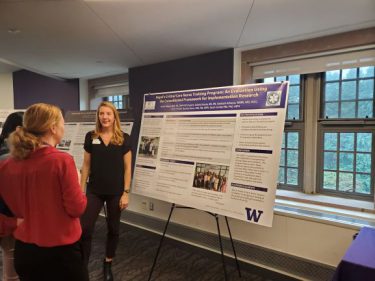
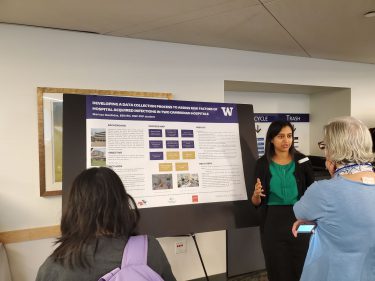
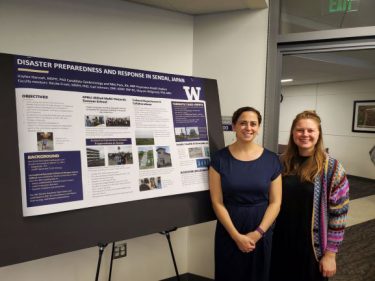
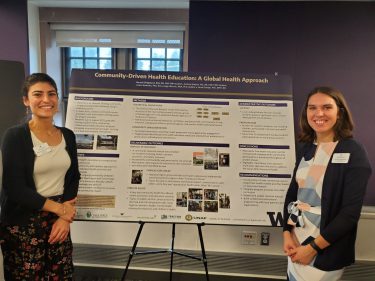
On November 14th, multiple departments came together to hear Sheila Davis speak about the growth of Partners in Health over the past 30 years. The event started with poster presentations from students engaged in global health projects over the past year. Andrea Shelton (DNP-Midwifery), Hannah Bridgeland (DNP-FNP), Nicole Bayard (DNP-FNP), Marissa Masihdas (DNP-FNP), Rikki Peck (DNP-FNP), and Haylea Hannah (PHD Candidate – Public Health) all presented about their work in Peru, Nepal, Cambodia and Japan.

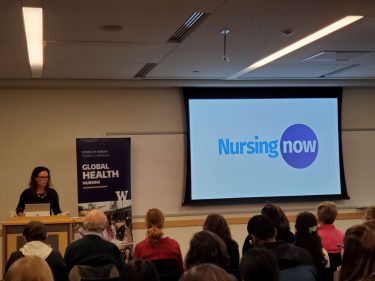
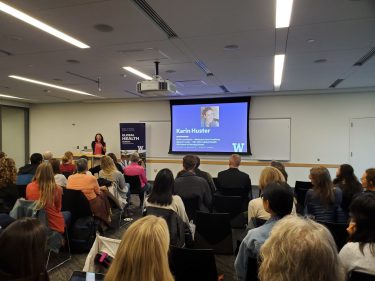
Sarah Gimbel, Co-Director of the Center for Global Health Nursing had a chance to introduce the School of Nursing and its commitment to the year of the nurse and midwife as presented by Nursing Now. She was pleased to welcome Karin Huster, an alumnus of the UW School of Nursing, who now works for Médecins sans Frontiers as a site coordinator and has worked closely with our keynote speaker, Sheila Davis.

Sheila Davis, CEO of Partners in Health, took the stage to discuss Partners in Health after 30 years and how the role of the nurse is important in the organization’s mission and in the overarching goal of global health equity. Sheila took the audience on a trip through her nursing career which has led her to become the CEO, how the organization is embracing her perspective as a nurse and the steps nurses must take in the future in order to care for the world’s most vulnerable populations.

The Center for Global Health Nursing wants to thank the UW School of Nursing, the Population Health Initiative, I-TECH, and the Department of Global Health for helping sponsor this event.

CEO of Partners in Health, Sheila Davis, to Visit UW


November 14th, 2019  at HUB 250
Poster viewing 2:30 – 3 pm, Presentation 3 – 4 pm


Picture of CEO of Partners in Health, Sheila Davis

Dr. Sheila Davis is the Chief Executive Officer at Partners In Health (PIH). Previously, she served as Chief of Clinical Operations and as Chief Nursing Officer, where she oversaw nursing efforts as well as supply chain, medical informatics, laboratory, infrastructure, and quality improvement activities. Starting in 2014, she served as the Chief of Ebola Response as she led PIH’s response efforts during the West Africa epidemic.  She has been a nursing leader in the field of HIV/AIDS since the mid-1980s and served on the National Board of the Association of Nurses AIDS Care (ANAC).  She entered the global health arena in 1999 responding to the global HIV pandemic working in a number of countries. She was the co-founder of a small NGO that worked in South Africa and Boston from 2004-2010 on health projects, including a rural village nurse clinic. Dr. Davis is a frequent national speaker on global health and clinical topics including HIV/AIDS, the Ebola epidemic, leadership in public health, and the role of nursing in human rights.

Dr. Davis received her BSN degree from Northeastern University in 1988, her Masters in Nursing degree as an Adult Nurse Practitioner in 1997 and her Doctorate in Nursing Practice with a concentration in global health in 2008. Both of her graduate degrees are from the MGH Institute of Health Professions.  Dr. Davis was a faculty member at the School of Nursing at the MGH Institute of Health Professions for 4 years and an Adult Nurse Practitioner at the MGH Infectious Diseases outpatient practice for over 15 years. Currently, she is Adjunct faculty at the UCSF School of Nursing and an affiliate member of Ariadne Labs. She was inducted as Fellow in the American Academy of Nursing in 2008 and in 2009 was inducted as a member of the inaugural class of 12 Carl Wilken’s Fellows working on anti-genocide global efforts as part of the Genocide Intervention Network.

Dr. Davis will join the Center for Global Health Nursing as part of UW Global Month, a university-wide initiative to highlight UW’s global impact, networks, and community. She will be speaking on the importance of advocating for nursing in global health with real-life cases from her work with PIH and will talk about the evolution of the organization. The event will also highlight student nurses and the global impact they have made while at the UW.

This is an event you don’t want to miss!

A huge thank you to our partners who supported the Center for Global Health Nursing for this event: I-TECH, UW Population Health Initiative and the UW Department of Global Health. 


Two SoN Students Part of Population Health Initiative’s 2019 Applied Research Fellowship

Two School of Nursing students were part of the Population Health Initiative’s 2019 Applied Research Fellowship. Jane Kim (DNP Student) and Michelle Shin (PhD Student) spent 10 weeks during the summer to analyze the maternity and infant wraparound services provided by First Steps to low-income individuals. To learn more about their findings and more about the fellowship offered by the Population Health Initiative,

please see link